
Is Europe Poised to Play a More Meaningful Role in Global Growth this Year?
Cyclical Upswings Bodes Well for the Continent
- Europe’s economic outlook is improving, with falling inflation, stabilising interest rates, stronger domestic demand, rising capital investment, and easing geopolitical risks such as the potential Russia–Ukraine ceasefire and increased LNG supply.
- Fiscal stimulus and improving corporate earnings are strengthening the recovery, as EU governments ramp up infrastructure, defence and digital investment, helping support margins, boost confidence, and drive expected 11.6% earnings growth in 2026.
After years of disappointment, it is understandable that investors remain cautious on Europe. Structural challenges have weighed heavily on the region’s growth potential: unfavourable demographics, political uncertainty, ongoing trade tensions with the US, and intense competition from Chinese imports have all contributed to a prolonged period of underperformance.
However, while the structural story remains challenging, signs of real recovery are beginning to emerge. Across the region, inflation has fallen back towards target levels, which has allowed monetary policy to normalise. The combination of lower inflation and a more stable interest‑rate is creating more favourable conditions for growth.
Beneath the surface, momentum too has picked up. During the second half of 2025, capital investment began to accelerate, supported by easing financial conditions and improving confidence. At the same time, domestic demand showed renewed strength, suggesting that – rather than stalling – growth can be sustained into the early part of 2026.
More Favourable Backdrop
While not eliminated entirely, some geopolitical risks, also appear to be improving. In particular, the prospect of a Russia – Ukraine ceasefire has gained traction. Even a partial de‑escalation would reduce risks to energy supply and trade flows, which have been a major drag on European growth since 2022. Europe now benefits from an ample Liquified Natural Gas supply, particularly from the US, a development that has significantly reduced the risk of energy shortages. Lower and more stable energy costs should ease pressure on both households and corporates, improving real incomes and helping European companies regain some competitive edge in global markets.
The European Union is also proactively managing trade challenges stemming from US tariffs and heightened competition from China by implementing new free trade agreements. These initiatives, among which a deal with MERCOSUR, a South American trade bloc, are strategically positioned to drive export growth for the EU in the coming year and support regional stakeholders in offsetting losses attributed to US tariff policies.
Shift in Fiscal Policy
After years of restraint, governments are now starting to roll out previously announced stimulus programs to strengthen European economies. There is renewed progress in spending plans that target infrastructure, defence, digitalisation, and industrial competitiveness. In defence alone, EU funding is well suited to meet these challenges, with the Re-arm Europe Pan – Readiness 2030 initiative offering up to €800 billion (about 3.7% of the EU's GDP).
This is particularly important for large economies such as Germany and Italy, where public investment has lagged for much of the past decade. Increased fiscal support should help offset some of Europe’s structural drags and reinforce domestic demand, enhancing the durability of the current recovery.
Improving Earnings Outlook
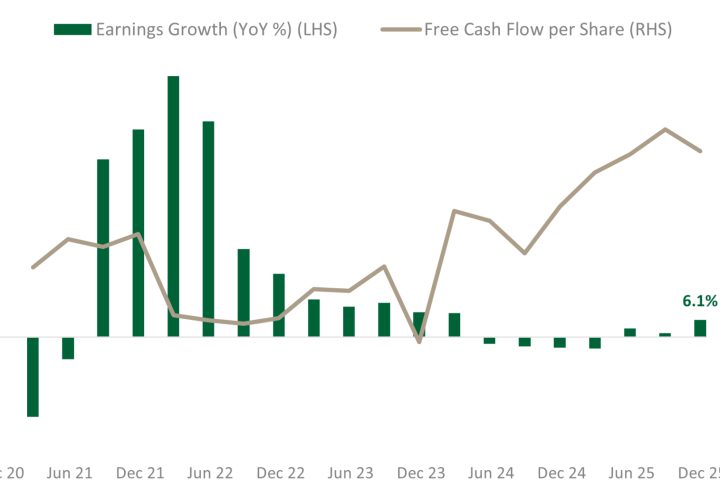
From an equity market perspective, this cyclical upswing is beginning to feed through into earnings expectations. European corporate earnings have been broadly stagnant for the past two years, reflecting weak growth and elevated costs. However, this is now improving.
Figure 1: Euro Stoxx 50 Index Earnings Growth and FCF
Source: FactSet, January 2026
Lower input costs, easing financial conditions and firmer demand are combining to support margins and revenue growth. Consensus forecasts point to earnings growing by 11.6% in 2026[1], a notable improvement after a prolonged period of stagnation.
Europe’s long‑term structural challenges should not be underestimated, and substantial reform will be required for region to regain global growth leadership. That said, the near‑term cyclical environment is improving faster than many investors anticipated. With earnings momentum turning positive, investors are seeing attractive opportunities starting to emerge.
Disclaimer
This communication has been prepared for information purposes only and is not intended for onward distribution. Opinions expressed here are as of the date of publication and subject to change without notice. It is not a recommendation to buy or sell any of the investments mentioned herein.
Past performance is not a guide to future returns. All investments risk the loss of capital.
Issued by Stonehage Fleming Investment Management Limited (SFIM). Authorised and regulated by the Financial Conduct Authority (194382) and registered with the Financial Sector Conduct Authority (South Africa) as a Financial Services Provider (FSP No. 46194).
[1] Source: FactSet, 2026 EPS Growth estimate, as of 15/01/2026
Email